
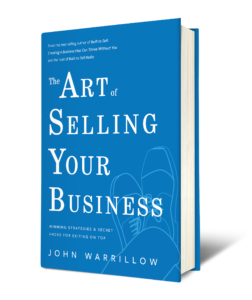
John Warrilow’s The Art of Selling Your Business

John Warrilow is the founder of The Value Builder System and accomplished author.  While not a business broker himself, Warrilow has gathered considerable knowledge and expertise on the industry.  His previous book Built to Sell was listed as one of the best business books of 2011.  In this article, we will explore some of the key points in Warrilow’s latest book, which is entitled The Art of Selling Your Business: Winning Strategies and Secret Hacks for Exiting on Top.  This book was released on January 12th, 2021 and is proving to be invaluable for business owners. 

Selling When the Time is Right

One key focal point of the book is that business owners should skip trying to find the perfect “magical time” to sell their business.  Additionally, Warrilow notes, “I make the strong recommendation in the book that the best time to sell your company is not during some mysterious macroeconomic environment.  It is when someone is willing to buy it and you get an offer.  And that is because at that point, you’re in the position of strength.”

The DIY Approach 

This book reinforces the fact that business owners truly need to work with an intermediary if they are to achieve optimal results.  Warrilow even includes his six reasons for why every business owner should hire a business broker or M&A advisor.

Many business owners think that they can simply handle selling their business on their own.  But the simple fact is that business owners usually have no experience in selling a business.  Add this to the fact that selling their business is likely to be the most important financial decision the business owner ever makes, and it quickly becomes clear that business owners are doing themselves a considerable disservice when they opt to handle everything on their own.  

A Business Broker vs. a Lawyer

As Warrilow points out, oftentimes business owners think that rather than working with a business broker or M&A advisor, they can turn to a trusted lawyer who has served them in the past.  But this thinking is flawed when it comes to successfully selling a business.  As Warrilow states, “a lawyer, almost by default, is going to be very conservative as everything exposes a lawyer to risk.  And that is why using a traditional attorney is almost always a mistake.” 

If you are planning to sell your business now or in the future, a book like Warrilow’s The Art of Selling Your Business: Winning Strategies and Secret Hacks for Exiting on Top can serve as a uniquely valuable tool in your toolbox.

Copyright: Business Brokerage Press, Inc.

rudi1976/BigStock.com

The post John Warrilow’s The Art of Selling Your Business appeared first on Deal Studio – Automate, accelerate and elevate your deal making.

10 Mistakes that Sellers Make

1. Not knowing what the business should sell for

One of the most costly errors a business owner can make is not knowing the approximate price of his or her business prior to entering the selling process. Although the marketplace ultimately determines the final price, an owner needs to know what the approximate price his or her business is prior to placing the business on the market. Before making the decision to sell, owners should work with someone qualified to place a price on their company.

An experienced business broker has both the technical ability and the market experience to produce the most realistic pricing opinion. The business broker will also be the only alternative for supporting his or her opinion by selling the business.

Fair Market Value

Asking Price is what the seller wants

Selling Price is what the seller gets

Fair Market Value is the highest price the buyer is willing to pay and the lowest price the seller is willing to accept.

2. Not preparing the business for sale

Determining the starting price point is only the first step. Prior to exposing the business to the marketplace, preparation is necessary. A business is certainly not a house, but the same attention to appearance prior to sale is necessary. Financial and legal affairs should be current. Anything a potential purchaser might want to see should be up-to-date, accurate and available for review.

Momentum is very important in business transactions and can make or break a deal. The constant need to develop information for a serious prospect will destroy momentum and with it, possibly, the deal. Demonstrating preparedness places the business in a favorable light and prospective buyers will feel comfortable that everything is in order. Being unprepared can delay a closing, create costly expenditures to play catch-up, and cause prospective purchasers to lose confidence in the deal itself. Too much time almost always works against the deal happening.

3. Not being able to see their business through the eyes of a buyer

This can be very difficult for any seller. It is only natural to see one’s own business in a most favorable light and overlook the blemishes or problems inherent in any business. Sellers have to approach their business realistically, knowing that a potential buyer will be doing the same. By recognizing the deficiencies of their business, sellers are in a much better position to deal with the concerns of the buyer. In fact, the best way to handle any potential problem areas is to bring them up in the very beginning.

4. Not really knowing the buyer

The better you know the buyer, the smoother the transaction. By knowing the buyers, their motives, their interests and their backgrounds, the better equipped a seller is to make informed decisions about whether they are the right people to operate the business. When final negotiations begin, knowing the buyers can help resolve some of the issues that will arise. Are their interests the same as yours? If you, as the seller, are financing the deal, do you feel confident that they can make the payments? The more you know about why a buyer wants to buy your business, the better position you are in to know when to be firm in the negotiations and when to be flexible.

5. Trying to sell the company to a buyer who doesn’t want to buy

There are usually many more potential buyers than there are businesses for sale. The question is — how serious are they? A buyer may indicate a great deal of interest but when it gets down to the wire, he or she may back out of the deal. Some buyers want to buy only on their terms and conditions, some may have too many decision-makers to please, and others only want to buy the “perfect” business. Wasting time on those who aren’t serious about purchasing a business takes away valuable time from those buyers who really want to buy.

6. Being your own worst enemy

Many business owners feel that no one knows their business like they do. They think they can do a deal by themselves. They don’t need, or want, any help. They think they are lawyers, accountants, business brokers and outside advisors all rolled up into one person. Then when the going gets tough, they become impatient and inflexible. They then blame others, usually the buyer, when the deal blows up. As the old saying goes: “The attorney who represents himself has a fool for a client.” The same could be said for the business owner who thinks he can sell his or her own business. Not using outside advisors, such as a professional business broker, is a serious mistake.

7. Not understanding the structure of the deal

Regardless of the size of the deal this could be the scenario: an offer is presented, the seller takes one look at the price, immediately says “no” and refuses to look any further. The price, within reason, is immaterial. The real crux of the deal is how it is structured. Consider the negotiating axiom “You can name the price if I can name the terms.” The terms and conditions are important. A seller may be ecstatic about price only to find that the devil is in the details.

8. Not being able to walk away from the deal

Too many sellers get so involved in trying to put a deal together that they don’t see the big picture. They don’t realize that the deal isn’t a good one. In other words, it’s time to walk away from the deal and go on to the next one. Many sellers don’t want to let the deal get away. Since they have invested a lot of time and effort, and probably expenses, it’s often difficult to just end it. However, in some cases that’s exactly what must be done. If the deal isn’t right, and can’t be fixed, there is no other choice. It’s much better not to do the deal than to do a bad one!

9. Waiting too long to sell

Too many owners wait until the last minute to decide to sell their business. They wait until business is down, or they are completely burned-out, or their business partnership has soured completely. The time to sell is before the emergency happens. The time to sell is when business is good. The time to sell is prior to when exasperation hits. The old adage is that a business owner should think about and plan the eventual sale of the business the day after it is started or purchased.

10. Changing your mind

The sale is progressing nicely, the buyer is happy and the seller well, the seller is contemplating life without the business. He or she realizes that when the business is gone, they will have nothing to do. The business has been a major part of their life for many years. Just before the closing, the seller decides that he or she can’t live without the business and the deal starts to unravel. Sometimes, seller’s remorse arises because a business acquaintance says the price was too low, or there isn’t enough cash involved or offers some other uninformed reason. If it was a good deal in the beginning, don’t let well-meaning outsiders influence the sale. And, if there is even a speck of doubt about selling the business, don’t begin the process. Wait until there is not one shred of doubt.

Copyright: Business Brokerage Press, Inc.

dlkushin/BigStock.com

The post 10 Mistakes that Sellers Make appeared first on Deal Studio – Automate, accelerate and elevate your deal making.

3 Steps for Achieving Pricing Power

The simple fact is that most of us want to control our own fate.  This fact is especially true for entrepreneurs and business owners.  However, the truth of the matter is that for most business owners, their fate isn’t completely in their own hands.  For example, a variety of forces can prevent businesses from establishing their own prices. 

Knowing whether or not your company has pricing power is essential and can influence a range of decisions that you may make.  Let’s take a closer look at what steps you can take to control your own pricing.

What is Pricing Power?

This economic term describes the effect of a change in a product price on the demanded quantity of said product.  Your company’s pricing power is linked to the demand for your products or services.  If you have a high level of pricing power, you can raise your prices over time and maintain your customers. 

Who Has the Greatest Pricing Power? 

It is no great secret that the Amazons, Apples, Wal-Marts and auto manufacturers of the world exercise a tremendous amount of power.  Part of this considerable, and seemingly ever growing, power resides in the fact that the size of these companies now rivals and even surpasses many nation states.  This grand level of power is unique in human history in many ways.  Along with it comes the ability to exercise an almost god-like authority over suppliers. 

Today, these ultra-powerful companies commonly dictate to vendors what prices they are willing to pay, and the quasi-monopolistic nature of these companies often leaves vendors with no choice to comply.  In short, these 900-pound gorillas are telling companies both large and small exactly how much they will pay for a given number of bananas. 

Step 1 – Providing a Branded Product or Service

If you discover that your company doesn’t have pricing power, there are steps you can take.  One step is to produce a branded product or service.  In this way, you are able to offer something of greater value than your competitors.  Through having a branded product or service, it is possible to create a higher perceived value in the minds of not just the Amazons of the world, but in the minds of consumers as well.

Step 2 – Innovating 

Another path towards achieving pricing power is through innovation.  A great example of leading the way in innovation is Apple.  While few companies have Apple’s almost ethereal resources, that is not to say that you cannot find ways to innovate within your own sphere or industry.  Small innovations can often have an outsized impact and help a business stand out from a crowded playing field.  Innovation that leads to patent production is an excellent way to gain a degree of pricing power.

Step 3 – Offering Exceptional Service

A third option for achieving a degree of pricing power is to provide what could be called “mind-blowing” service.  By providing service that is truly a cut above what the competitors can match, your company is positioned to achieve pricing power.  Providing your customers with something they simply can’t get elsewhere is a key way to setting a price that is more in line with what you desire.

There are many marketplace variables that your business can’t control.  The trick is to evaluate your business, your business’s potential and the concrete and practical steps you can take starting today to achieve pricing power. 

Copyright: Business Brokerage Press, Inc.

alexeys/BigStock.com

The post 3 Steps for Achieving Pricing Power appeared first on Deal Studio – Automate, accelerate and elevate your deal making.

How to Achieve High Buyer Success Rates

Both buyers and sellers have a lot of emotion wrapped up in their respective decisions. It’s completely natural to feel that way. Business Brokers and M&A Advisors can assist clients with their concerns and fears by giving them more information about how the sales process works and also discussing common pitfalls to avoid. In this article, we’ll go over some of the various issues impacting buyers. If you are able to anticipate potential issues that could interfere with the deal, you’ll be more likely to be able to overcome those issues. 

The Initial Intake Process 

Buyers should understand that they will need to sign an NDA and treat the non-disclosure process seriously. Brokers representing a seller will be requiring a good deal of information, including financial details, and often even your resume. So don’t be surprised when you’re asked for this information. It’s all a normal part of the process. 

The Lending Process

It’s important to realize ahead of time that the lending process can be slow. It is also very common for lenders to ask for more and more information before the approval goes through. If this happens to you, don’t panic or worry. This too is a standard method of operation. 

Working with Lawyers 

While lawyers are obviously necessary in the process of buying and selling a business, they can also be a source of anxiety. In their efforts to protect their clients, they also can often kill a deal. Of course, get the facts and logistical information that you need from a lawyer, but always remember that lawyers and other business advisors are not the decision makers. If you’re buying a business, the decision is ultimately yours. 

The Non-Binding Offer 

A non-binding offer allows both the buyer and seller to walk away from a deal if terms cannot be agreed upon in a set amount of time. A non-binding offer shows the seller that the buyer is interested in acquiring the business, but this form of agreement isn’t legally binding. The benefit of the non-binding offer is that it allows discussions and negotiations to move forward.  

The Due Diligence Process

The due diligence process is another aspect that allows the buyer to move forward, while simultaneously having protection. At this point, the buyer will receive confidential and sensitive information about a business, such as the financials, inventory, and legal matters. Buyers will also have the ability to conduct additional research and ask the sellers questions. Like the non-binding offer, the due diligence process also means that you have the right to walk away. It is important to have this step available so that buyers can make the most informed decisions possible.

Business brokers and M&A advisors are essential in order to help buyers find the best fit. We not only save our buyers time and energy, but  we also help to ensure that the transaction goes as smoothly as possible.

Copyright: Business Brokerage Press, Inc.

cclimj/BigStock.com

The post How to Achieve High Buyer Success Rates appeared first on Deal Studio – Automate, accelerate and elevate your deal making.

Is Your Business Charging Enough For Goods & Services?

A small increase in what you charge for your goods and services can make a tremendous difference to your bottom line.  The fact is that many businesses could charge more for their goods and services than they do, but fail to do so.  Owners often do not realize the great value of charging just one-percent more.  In this article, we’ll explore how charging even slightly more can dramatically impact your business.

Let’s consider a hypothetical example.  A business owner tells a potential buyer that he or she could safely increase their prices by 1.5% and do so without the price increase causing any negative impact to sales or business disruption.  The savvy buyer quickly realizes that the business, which has $70 million in sales, is leaving $1 million dollars on the table by not increasing its prices by 1.5%.  A smart buyer realizes that after purchasing the business, all he or she has to do is institute this small price increase in order to achieve a sizable increase in profits.

In his best-selling book The Art of Pricing, Rafi Mohammed explores the often-overlooked area of pricing.  He keenly observes that one of the biggest fallacies in all of business is to believe that a product’s price should be based on the cost of the product.  In The Art of Pricing, Mohammed points to several examples.  One comes from the restaurant industry.  He points to the fact that McDonald’s keeps entrée prices attractive with the idea of making up profit shortfalls in other areas, ranging from desserts to drinks and more.  Or as Mohammed points out, McDonald’s profits on hamburgers is marginal.  However, its profits on French fries are considerable.

Mohammed’s view is that companies should always be looking to develop a culture of producing profits.  He states, “through better pricing, companies can increase profits and generate growth.”  Importantly, Mohammed points out that it is through what he calls “smart pricing” that it is possible to extract hidden profits from a business.  Summed up another way, pricing couldn’t matter more.

All too often business owners, in the course of their day-to-day operations, fail to place sufficient importance of pricing.  Any business looking to achieve more will be well served by first stopping and taking a good look at its pricing structure. 

Likewise, buyers should be vigilant in their quest to find businesses that can safely increase prices without experiencing any disruption.  At the end of the day, small changes to pricing can have a profound impact on a company’s bottom line.

Copyright: Business Brokerage Press, Inc.

354288095/BigStock.com

The post Is Your Business Charging Enough For Goods & Services? appeared first on Deal Studio – Automate, accelerate and elevate your deal making.

How Understanding Psychology Can Benefit Your Deals

We work closely with our clients to preserve the integrity of deals so that they have the best chance of a successful closing. An often-overlooked aspect of the process is understanding and embracing human psychology. In this article, we will explore some of the most common ways that psychology comes into play. 

The Element of Time

It is critical that both buyers and sellers feel well prepared at every stage of the process. It is also essential that a certain momentum is established through every stage of the deal. When too many delays happen, this can start to derail deals. 

Think about the Buyer and the Seller 

For both parties, the buying or selling of a business is a life-changing event. For this reason, it is important that you invest the time to think about the point of view of the other people involved. No doubt, buying and selling can be stressful, so it’s important to take other people’s thoughts and feelings into account. You are not the only one who may be experiencing a little stress. 

The Issue of Non-Active Partners

In some deals, non-active partners can pose challenges to finalizing deals. They often have different motivations than the seller who is in the role of running the business. In a situation where two sellers have divergent goals, it can pose a challenge to a deal. The best thing to do is to try to understand the point of view of each seller and help them both reach their respective goals. 

Identify Influencers

Influencers and recommenders can have a powerful sway over both buyers and sellers. By influencers, this could mean accountants, lawyers, relatives, etc. In order for a deal to go through successfully, often these influencers must be identified and their viewpoints must be addressed. On a practical level, there are also other people involved that can interfere with a deal, such as landlords. It’s important to make sure that these individuals feel as though they will benefit from the success of the deal as well. 

There are many moving parts needed to get to the finishing line. Human psychology plays a huge role in what decisions get made. It’s vitally important to take the time to consider what others involved in the deal might be thinking or doing. Your Business Broker or M&A Advisor will benefit you by getting to know all parties involved and taking the appropriate actions to ensure things are done to the satisfaction of all parties. 

Copyright: Business Brokerage Press, Inc.

Wavebreak Media Ltd/BigStock.com

The post How Understanding Psychology Can Benefit Your Deals appeared first on Deal Studio – Automate, accelerate and elevate your deal making.

When Should You Think About Selling Your Small Business?

There are many reasons why small companies are put up for sale.  Some of the more common reasons can actually have little to do with the company’s general performance.  For example, many small business owners discover that they need to sell for health reasons or personal concerns, such as divorce or partnership issues.  While a business downturn or fear of a larger competitor looming on the horizon might prompt many business owners to sell, economic drivers are not the only issue.  Owners may want and need to sell, but often it isn’t always that simple.

Many business owners are looking to retire, but are unpleasantly surprised to learn that they simply can’t afford to do so.  Still yet, many business owners don’t truly want to retire or sell, but instead they just want more freedom in their lives.  The day-to-day responsibilities of owning and operating a small business can take their toll.  Many business owners are looking to make a change and would love to be free of this burden.  This class of owner has already “checked out” mentally, and this can have profound negative consequences for their businesses.

When an owner wants out but discovers that he or she simply can’t afford to sell or retire, it will come as no surprise that there is usually an accompanying drop off in enthusiasm.  Ultimately, the vast majority of owners will start to lose focus.  Often, we find that they stop investing the capital necessary to continue the growth of the business, which can trigger other events, such as the loss of key staff members and/or customers.  Losing a top customer to a major competitor can further accelerate the downward spiral.  The failure of the business to maintain its footing and competitive advantage can lead to a more aggressive posture by existing competitors or even encourage a new competitor to move into the market.

In time, the owner may come face-to-face with the harsh realization that they have no choice but to sell if they are to salvage any of the business’s value.  The best way for a business owner to safeguard against this situation is to sell when his or her business is doing well, as this helps to ensure an optimal price. 

Working with a business broker, even years before one is interested in selling, is one of the single smartest moves any business owner can make.  The time to think about selling your business is now, as no small business owner knows what life or the market will bring.

Copyright: Business Brokerage Press, Inc.

Rido81/BigStock.com

The post When Should You Think About Selling Your Small Business? appeared first on Deal Studio – Automate, accelerate and elevate your deal making.
12 Ways to Increase the Value of Your Company

1. Build a solid management team. A business with sales of $5 million and up needs a full complement of officers and directors. Such a team might include: a COO, a CFO, a sales manager and, depending on the of type business, an IT director. It is also beneficial to create a Board of Directors with at least two outside members. This professionalization of management can remove the stigma of “the one man band.” Not only will this build a stronger company, it will increase the value to a possible acquirer. Smaller firms should also build a strong management team, and creating an outside advisor group is also a good idea.

2. Loyal employees.  Happy and loyal employees make for a strong company. Top management should have non-compete and/or confidentiality agreements.  Solid benefits plans for all employees should be in place. A company’s greatest asset is its employees and perhaps its biggest value-increaser.

3. Growth. Some smaller companies are kept small to maximize the owner’s benefits – the proverbial “cash cows.” However, if building value is the goal, then developing new products or services, building market share, expanding markets or opening new ones, is critical. This generally requires a financial investment, but building a strong growth rate also builds value.

4. Understanding your market. The value of a company may be contingent on its industry, its place in the industry and the direction of the industry itself. How big is the industry, is it headed up or down, who is the competition and how big is the company’s market share? Is it time to change direction or diversify?

5. Size counts. Companies with less than $5 million in sales and an EBITDA of less than $1 million can be perceived as small. Therefore, they may be dependent on continuing outside financing and lack the critical mass for both buying and selling power. These companies can be perceived as too small for acquisition or are penalized when it comes to value. However, over the past few years corporate buyers, as well as private equity firms, have seen the advantages of purchasing smaller firms. Obviously, companies with $10 million or more in sales and an EBITDA of $1 million or more are considered as solid and able to stand on their own.

6. Changing direction.  Small companies can be very adept at changing course and implementing change. They have to be able to change and move quickly to take advantage of new markets, to fill voids in existing markets and even to add or change products or services.

7. Documentation. Business plans, financial plans and personnel plans should all be in writing – and kept current. Terms of employment agreements should be spelled out and in writing. Business planning and company objectives, etc., should also be in writing and reviewed periodically. Contracts should be reviewed and maintained on a current basis.

8. Diversification. A major problem with many small companies is that their business is concentrated on one or two major customers or clients. Ideally, no customer or client should represent more than 10 percent of sales. Expanding to new markets, introducing new products, and finding new customers must be considered without deviating too far from the company’s core business.

9. Name and brand identity. Nothing beats the name Walt Disney, or Kleenex® or the soft drink called Coke® – they are household names. Small firms may not have the brand or name recognition of these companies, but they can work at it. This recognition is especially powerful in the consumer product area. But franchising has expanded this name or brand recognition to many different types of businesses.

10. Taking advantage of proprietary and other assets. Patents, brand names, copyrights, alliances, and joint ventures are all examples of not only proprietary assets, but, in many cases, valuable ones. Even equipment can be used in several different ways. Large landscape companies in cold climates put snow plows on their trucks, utilize their existing workforce and become a snow plowing company for their regular landscaping customers — office complexes, apartment and condo developments, etc.

11. “Lean and Mean.”  Many companies lease their real estate needs, outsource their payroll, have their manufacturing done offshore, or have UPS handle all of their logistical needs. Since all non-core requirements are done by someone else,  the company can focus its efforts on what they do best.

12. Do it now! The owners of small firms, even large ones, have an attitude that says, “I don’t have time now, I’ll do it tomorrow” or “I’m too busy now putting out fires.” So the real challenges of building the business, and value, get sidetracked or put off indefinitely. Creating value is critical to the long-term (and short-term) success of the business.

Keep in mind that the best time to consider selling is when business is good, the business is running profitably, and many of the above “value-adders” are in place. By contacting your local professional intermediary you can explore which of the above will add the most value to your firm, so it will be ready to sell when you are.

Copyright: Business Brokerage Press, Inc.

insta_photos/BigStock.com

The post 12 Ways to Increase the Value of Your Company appeared first on Deal Studio – Automate, accelerate and elevate your deal making.

The Psychology of Selling – Are You Sure You’re Ready?

More than likely, selling your business is one of the biggest decisions of your life.  Unless you own a business, it is impossible to understand just how all-encompassing of a process it can be.  With that stated, it is important for business owners to step back and seriously reflect on whether or not they are truly ready to sell.  The psychological aspects of selling are not trivial.  Various aspects must be taken into consideration before initiating the process to sell.

There are many reasons why it is vital to step back and think about whether or not you are really ready to sell your business.  Far too many business owners believe they are ready to sell, only to discover (much too late) that an executed sale is not optimal for their plans. 

Selling When There is No Other Choice 

Selling a business because there is no other choice, such as situations concerning failing health, personal issues or problems with a business partner, isn’t a true choice at all.  In this situation, the psychology of selling is essentially irrelevant, as you have one option, namely, to sell.

The Case of Burnout 

In other cases, owners eventually hit a brick wall and have no choice but to consider selling.  As burnout sets in, owners may feel that the time is right to “hang up their hat” and put their business up for sale.  However, as the process evolves, even those experiencing some level of burnout can discover that they are not emotionally or psychologically ready to sell.  In many cases, people make this realization only once it is too late.  

Take the Time for Self-Reflection 

Quite often, a company becomes interwoven into a business owner’s sense of self, sense of place in the world and even, to an extent, sense of self-worth and identity. When business owners are unaware of this fact, it can be something of a shock to their system to begin the sales process.  Many people simply are unaware of the strong hold that their business has on them. 

Owners need to invest some time in self-reflection and ask four key questions: Do I really want to sell?  If the answer is yes, then why do I want to sell?  Will I regret selling once my business is sold?  What will I do after I have sold my business?  Answering these questions involves far more than evaluating your business.  They also involve diving into emotional issues that could be central to your future.

Are You Really Ready to Sell? 

One of the best ways of determining whether you are ready to sell, and preparing your business for that potential sale, is to work with a business broker or M&A advisor.  Business brokers are experts at helping business owners deal with every aspect of the process of selling a business.  They can act as experienced guides that can use that experience and expertise to help you determine if you are truly ready to sell. 

If it turns out that you are indeed ready to sell, a brokerage professional can help you prepare so that you can achieve the best price possible once your business hits the market.

Copyright: Business Brokerage Press, Inc.

insta_photos/BigStock.com

The post The Psychology of Selling – Are You Sure You’re Ready? appeared first on Deal Studio – Automate, accelerate and elevate your deal making.

What Makes Your Company Unique in the Marketplace?

There are unique attributes of a company that make it more attractive to a possible acquirer and/or more valuable. Certainly, the numbers are important, but potential buyers will also look beyond them. Factors that make your company special or unique can often not only make the difference in a possible sale or merger, but also can dramatically increase value. Review the following to see if any of them apply to your company and if they are transferable to new ownership.

Brand name or identity

Do any of your products have a well recognizable name? It doesn’t have to be Kleenex or Coke, but a name that might be well known in a specific geographic region, or a name that is identified with a specific product. A product with a unique appearance, taste, or image is also a big plus. For example, Cape Cod Potato Chips have a unique regional identity, and also a distinctive taste. Both factors are big pluses when it comes time to sell.

Dominant market position

A company doesn’t have to be a Fortune 500 firm to have a dominant position in the market place. Being the major player in a niche market is a dominant position. Possible purchasers and acquirers, such as buy-out groups, look to the major players in a particular industry regardless of how small it is.

Customer lists

Newsletters and other publications have, over the years, built mailing lists and subscriber lists that create a unique loyalty base. Just as many personal services have created this base, a number of other factors have contributed to the building of it. The resulting loyalty may allow the company to charge a higher price for its product or service.

Intangible assets

A long and favorable lease (assuming it can be transferred to a new owner) can be a big plus for a retail business. A recognizable franchise name can also be a big plus. Other examples of intangible assets that can create value are: customer lists, proprietary software, an effective advertising program, etc.

Price Advantage

The ability to charge less for similar products is a unique factor. For example, Wal-Mart has built an empire on the ability to provide products at a very low price. Some companies do this by building alliances with designers or manufacturers. In some cases, these alliances develop into partnerships so that a lower price can be offered. Most companies are not in Wal-Mart’s category, but the same relationships can be built to create low costs and subsequent price advantages.

Difficulty of replication

A company that produces a product or service that cannot be easily replicated has an advantage over other firms. We all know that CPA and law firms have unique licensing attributes that prevent just anyone off of the street from creating competition. Some firms have government licensing or agreements that are granted on a very limited basis. Others provide tie-ins that limit others from competing. For example, a coffee company that provides free coffee makers with the use of their coffee.

Proprietary technology

Technology, trade secrets, specialized applications, confidentiality agreements protecting proprietary information – all of these can add value to a company. These factors may not be copyrighted or patented, but if a chain of confidentiality is built – then these items can be unique to the company.

There are certainly other unique factors that give a company a special appeal to a prospective purchaser and, at the same time, increase value. Many business owners have to go beyond the numbers and take an objective look at the factors that make their company unique.

Copyright: Business Brokerage Press, Inc.

Image Eng/BigStock.com

The post What Makes Your Company Unique in the Marketplace? appeared first on Deal Studio – Automate, accelerate and elevate your deal making.